Quick answer: To get the most out of a mobile tour, treat it as three campaigns in one — an in-person engagement engine, a content-generation machine, and a data collection tool. Set one measurable goal, match your vehicle and route to your audience and product availability, build a dedicated photo/UGC moment into every stop, staff it with trained brand ambassadors, and track reach, engagement, and outcome metrics at each market so you can compare performance and prove ROI.
Mobile marketing tours are one of the most effective ways to extend a brand activation across a wide footprint, but a tour that’s merely present in a market is very different from one that’s working in that market. Below, we answer the questions marketers ask most often when planning, running, and optimizing a mobile tour — the same questions our team at Inspira fields on every kickoff call.
What does it mean to “get the most out of” a mobile tour?
Getting the most out of a mobile tour means maximizing consumer engagement, content generation, and measurable data at every single stop — not just showing up with a branded vehicle. A mobile tour that only delivers samples is missing two-thirds of its potential value: the social content it could be generating and the consumer insight it could be capturing. The strongest tours are built so that engagement, content, and data collection all happen simultaneously, at every market on the route.
How do you plan a mobile tour that maximizes ROI?
Start with one clear, measurable objective — awareness, trial, data capture, or sales lift — because that single decision shapes your vehicle choice, your route, your staffing, and your success metrics. From there:
- Confirm product availability first. A mobile tour is a poor investment if the product isn’t on shelves in the markets you’re visiting. The excitement a tour generates needs somewhere to go immediately, or you lose the moment.
- Match the vehicle to the experience. A food truck works for taste-driven trial; a branded trailer or tour bus works better for immersive, multi-sensory brand worlds.
- Design for data from day one. Build simply to capture emails, social handles, or survey responses at every stop so the tour leaves you with more than photos.
For a deeper walkthrough of this process, see our beginner’s guide to launching a mobile marketing tour.
How do you choose the right route and markets for a mobile tour?
Choose markets based on where your product is already available for purchase, where your target audience over-indexes, and how efficiently stops can be sequenced without burning activation time on the road. A mobile tour hits multiple markets by design — that’s the point — but a route built purely around geography instead of audience-and-distribution fit will underperform even with a great activation. Before locking a route, map it against:
- Retail/product distribution in each market
- Regional audience-brand affinity
- Local events, festivals, or high-traffic dates you can piggyback on
- Realistic drive times between stops
How do you get more social media and UGC from a mobile tour?
Build a dedicated, camera-ready moment into every stop and give people a reason to post that goes beyond “I got a free sample.” Consumer content creation at live experiences is already extremely high — an estimated 98% of consumers create content for social media at events and experiences — so the opportunity is there by default. To capture more of it:
- Design one clear photo/video moment per activation (a backdrop, a prop, a signature product visual)
- Use hashtags that are trending locally in each market you visit, not just your national campaign tag
- Time email and social targeting to reach consumers in a region before the tour arrives, so awareness is already building
How do you measure the success of a mobile tour?
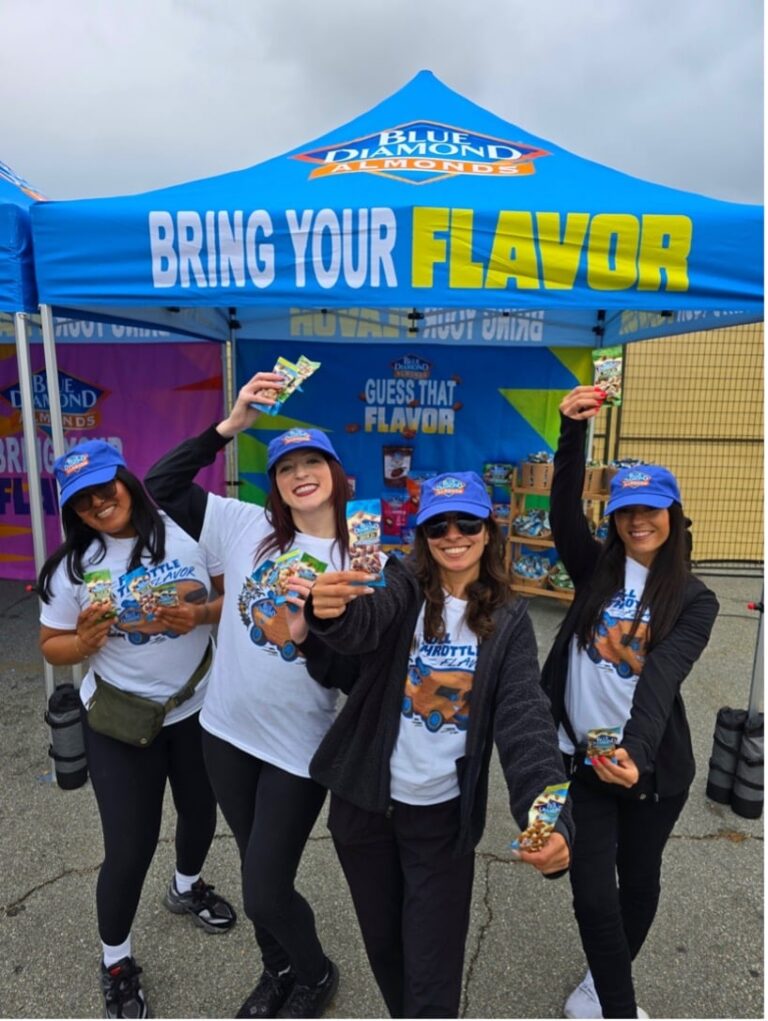
Measure a mobile tour across three layers: reach (impressions, foot traffic, media coverage), engagement (samples distributed, dwell time, interactions per stop), and outcome (leads captured, UGC volume, sales lift, and regional sentiment). Comparing these metrics stop-to-stop and market-to-market is where mobile tours earn their keep — you can see exactly where the message landed hardest and adjust the remaining route in real time. One Inspira mobile tour for Blue Diamond Almonds, for example, generated 2.2 million event impressions across an 11-market, 22,000-mile route — proof that the right measurement framework turns a tour into a national campaign, not just a series of local pop-ups.
How do you make a mobile tour cost-effective on a tight budget?
Reuse the same vehicle, staff, and creative assets across every market instead of customizing per stop — the reusability across regions is exactly what makes mobile tours cost-efficient compared with building separate local activations. A few additional ways to stretch the budget:
- Bundle nearby markets into a single, efficient route
- Lean on organic social and locally targeted email instead of paid local media
- Let consumer-generated content do the amplifying — it’s often the highest-ROI output of the entire tour
For a full breakdown, see how to plan a successful mobile tour on a tight budget.
What staff do you need to run a successful mobile tour?
A successful mobile tour needs experienced brand ambassadors who can answer product questions on the spot, a tour manager to coordinate logistics across markets, and professional drivers who can handle long, multi-city routes reliably. Ambassador quality in particular is one of the biggest levers on engagement — a team that’s genuinely knowledgeable and enthusiastic about the product converts far more passersby into participants than a team that’s just handing out samples.
What are the biggest mistakes that keep a mobile tour from performing?
The most common mistake is launching before product distribution is ready in the markets you’re visiting, which caps the tour’s ability to convert excitement into sales. Other frequent missteps include choosing a route based on geography alone rather than audience fit, under-investing in staff training, and treating content/data capture as an afterthought instead of building it into the activation itself. For a closer look at these pitfalls, see 6 things to consider before launching a mobile tour.
The bottom line
A mobile tour earns its full value when engagement, content, and measurement are designed in from the start — not bolted on after the vehicle hits the road. Brands that plan for all three consistently see mobile tours outperform their cost, generating brand relationships (and data) that outlast the tour itself.
Ready to plan a mobile tour that works as hard as it travels? Talk to Inspira’s experiential team about your goals.